
Partner Article
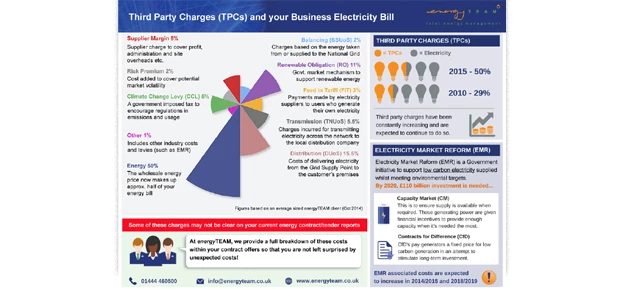
Third Party Charges approximately 50% of electricity costs
National energy consultancy, _energy_TEAM, have recently published an infographic breaking down third party elements of commercial energy bills.
Third Party Charges (TPCs) are generally increasing at a greater percentage than the wholesale energy price and are therefore having a big impact on energy costs. For example, for electricity, TPCs can now account for approximately 50% of the delivered electricity bill price compared to about 30% five years ago. energyTEAM’s latest infographic provides a breakdown of the TPCs that are built into the final price on commercial energy bills.
Businesses are beginning to realise the importance of these elements during the contract renewal and negotiation process. Some of these elements may not be recognisable within current electricity invoices or within tender negotiation reports. Therefore, working with an experienced energy broker or supplier that can help you to understand these costs, and how you can limit their impact, will be vital for businesses looking to place energy contracts going forward.
Additionally, with new Energy Market Reform (EMR) Charges such as Capacity Market (CM) and Contracts for Difference (CfD) to be introduced from April 2015, business procurement managers should be taking special care to ensure that they fully understand the terms and conditions regarding these costs within their new energy contracts.
To find out more about these charges, how they may affect your business and what you can do to limit the impact of these costs, call _energy_TEAM today on 01444 460500 or email us at email@energyteam.co.uk to arrange a free consultation.
This was posted in Bdaily's Members' News section by Energy Team (UK) Limited .
Enjoy the read? Get Bdaily delivered.
Sign up to receive our popular morning National email for free.
Our Partners




 Can you really judge someone by their CV?
 Are you flying too close to business burnout?
 Making education a lot better for a lot more
 Have we made it harder for young people to succeed?
 Celebrating Nissan's North East success story
 Are you a meat proxy?
 Engaging the five-generation workplace
 Talent is an asset, not an operational resource
 Taking advantage of the opportunities ahead
 Accountability isn’t the enemy of empathy
 Act now to avoid a last-minute tax scramble
 How inner-city living can transform a city by the sea