
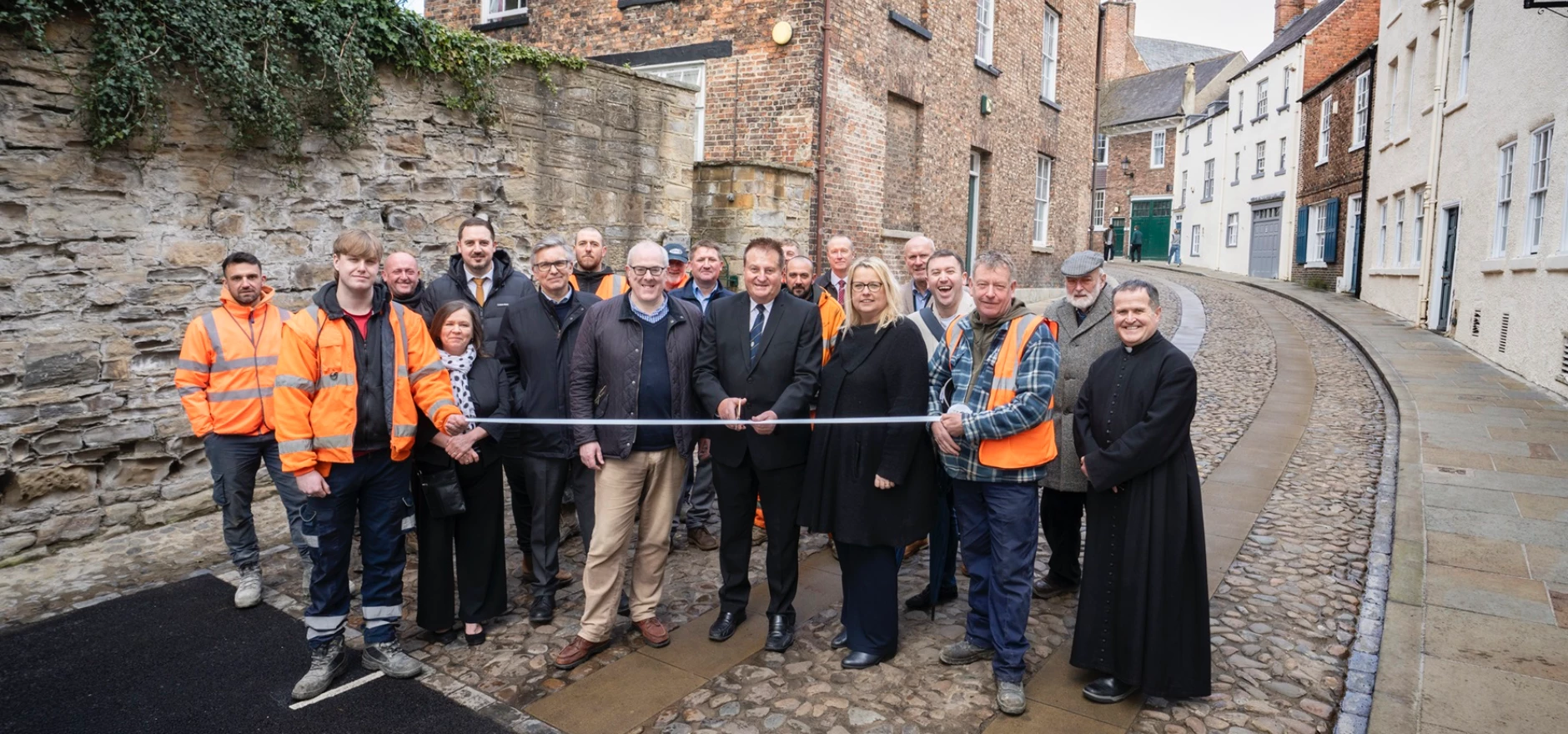
Durham’s historic footpaths restored
A well-known historic route in Durham City has been restored following extensive refurbishment.
Durham County Council has completed work on North and South Bailey, known collectively as The Bailey, which derives its name from the outer bailey of the Norman motte-and-bailey Durham Castle, running from Prebends Bridge past Durham Cathedral and many of Durham University’s colleges and buildings.
The council has laid natural stone footpaths and kerbs, replacing the cobbles and resurfacing the carriageway while preserving as much original material as possible to “ensure the longevity of the street and its character”.
A ribbon-cutting ceremony marked the project’s completion, attended by council members and representatives from Durham Cathedral and Durham University.
Councillor John Shuttleworth, Durham County Council’s cabinet member for highways, rural communities and community safety, said: “This marks a significant milestone in preserving the heritage and improving the infrastructure of The Bailey.
“As a high footfall area and close to university buildings, The Bailey is a popular path leading to Prebends Bridge and the riverbanks.”
The council has also restored the South Bailey sewer gas destructor lamp, invented by Joseph Edmund Webb in the 1890s, which was designed to burn off dangerous sewer gases such as methane.
While Webb was from Birmingham, many of his lights were installed in the North East and can also be seen in Whitley Bay, Monkseaton and Blyth.
Want your business, product or service to be seen regionally and nationally? Bdaily helps you get your story in front of the right audience, every day. Find out how Bdaily can help →
Join more than 55,000 subscribers by signing up to our daily bulletin each morning here.
Enjoy the read? Get Bdaily delivered.
Sign up to receive our daily bulletin, sent to your inbox, for free.
Our Partners




 Budget must replace pessimism with productivity
 What does collaboration really mean in business?
 Why NE6 is the real Northern Powerhouse
 Can you really judge someone by their CV?
 Are you flying too close to business burnout?
 Making education a lot better for a lot more
 Have we made it harder for young people to succeed?
 Celebrating Nissan's North East success story
 Are you a meat proxy?
 Engaging the five-generation workplace
 Talent is an asset, not an operational resource
 Taking advantage of the opportunities ahead